
Third Front: Putin Once Again Destabilizes Situation in Moldova to Stab Ukraine in the Back
During a massive Russian missile strike in Ukraine on Monday, October 31st, one of the missiles fell in the village of Naslavcea in Moldova.

 Follow us on Google
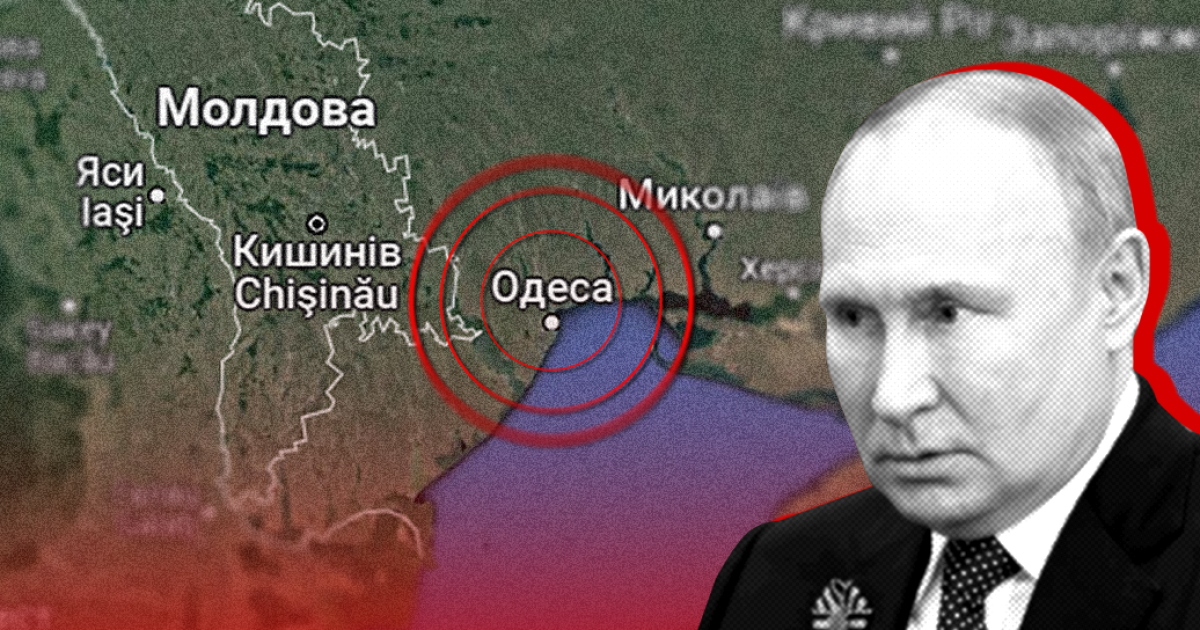
Moscow probably targeted the dam of the Dniester hydroelectric power plant, 10 km from the Naslavcea dam. The missile was shot down by a Ukrainian anti-aircraft systemб иut the fallen debris damaged several houses.
This is not the first such case. Russia has repeatedly used Moldovan airspace to attack both southern and northern parts of Ukraine. Russian drones were also noticed within 5-10 km of the Romanian, i.e. NATO border.
The Moldovan Ministry of Defense responded rather cautiously, saying that they had not detected enemy missiles in their skies. And there is a reason for that: Moldovan experts and journalists say that the country simply has nothing to answer to Russia. The Moldovan Foreign Ministry condemned another war crime of the Kremlin against Ukraine, and then, unexpectedly, expelled an employee of the Russian embassy, declaring him persona non grata.
All of this happened against the backdrop of an article in The Washington Post that made a lot of noise. It said that the FSB was working to overthrow the pro-Western government in Moldova with the hands of pro-Russian Moldovan politicians who had fled abroad. Moreover, recently Putin and the Kremlin propaganda started talking about Odessa again, saying that first they should destroy the port there and then take the city in order to cut Ukraine off from the sea. It is not for nothing that Russia announced the suspension of its participation in the grain deal.
Transnistria is another important consideration. Russia again began to undermine the already fragile political structure in Moldova. The pro-Russian politicians for a long time arranges the anti-government rallies with the requirement of change of the power. And the statements of President Maia Sandu speak for themselves: "If Russia threatens Moldova, we will defend ourselves."
Has Putin really decided to use Transnistria to open a third front against Ukraine in addition to the Belarusian one? Does Russia have the strength to do so? And what could be NATO's response? TSN.ua decided to found out.
Transnistria Factor
In April, two months after Russia's large-scale war against Ukraine began, news of a series of explosions in Transnistria rocketed the media space. At the same time, Russia began aiming missiles at the bridge over the Dniester Estuary, and the Western media reported that Putin was preparing to invade Moldova.
At that time, our intelligence called it nothing more than Russian psychological pressure, while at the same time recording some activity at the airfield in Tiraspol. In fact, so was the Belarusian direction all this time, until recently Putin really began to accumulate his troops there. Transnistria, we should remind, is an unrecognized even by Russia republic in the east of Moldova, where a Russian (Soviet) military contingent is still stationed.
Estimates differ as to its exact number. Ruslan Bolbochan, the former ambassador of Moldova to Ukraine, spoke about 1,500 Russian soldiers and 20 thousand tons of ammunition. The mass media have mentioned the figure of 1,700 personnel. Thus, Ukrainian intelligence reported that there were really only 300 combat-ready troops and decommissioned ammunition. In spring, Russia did not hide the fact that it wanted to create a land corridor to Transnistria via Odessa, completely cutting off Ukraine from the sea.
However, it all came to naught. The threat from the Moldovan direction was forgotten until the summer, when Ukraine and Moldova received candidate status to EU membership. At that time, Dmitry Medvedev, Deputy Chairman of the Security Council of the Russian Federation, said that Moldova would try to accelerate its membership in the European Union by uniting with Romania. Russian propaganda broke the fake that Moldova was preparing to "invade" Transnistria in collusion with Romania and with NATO support.
Moldovan Prime Minister Natalia Gavrilita responded to this in July in an interview with The Wall Street Journal: Moldova is worried that it could become the next victim of a Russian military invasion; this is a hypothetical scenario, but the situation could change.
Analysts at the European Council on Foreign Relations, assessing Russia's various options for destabilizing Moldova and overthrowing the pro-European government led by Maia Sandu, wrote:
"The three most likely scenarios for Russian aggression are: military action from Transnistria; a local, elite-focused uprising similar to what Russia did in Donbas in 2014, and likely to be concentrated in Gagauzia; and popular unrest that would contain elements of violence.".
Destabilization of Situation
It seems that amid military defeats in the war against Ukraine and insufficient power resources, the Kremlin has resumed its hybrid operation because of local protests in Moldova actually inspired by Russia, since Putin obviously hasn’t abandoned his idea of restoration of the USSR. He still seeks to occupy the entire Ukraine, Moldova, and other former Soviet republics. He just doesn't have the strength and resources to do so right now.
Before losing the presidency, Igor Dodon was the leader of the fifth pro-Russian column in Moldova. Now Moscow is looking for an alternative, and, it seems that it has found it. For several months, the anti-government protests inspired by Russia have not subsided in Moldova. Behind them is Ilan Shor who appears in a number of criminal proceedings. Against him and his party, the U.S. has imposed sanctions for destabilizing the situation in Moldova. He himself is abroad, as well as the scandalous oligarch Vlad Plahotniuc. For a long time it was believed that Vlad Plahotniuc "holds" almost all of Moldova. However, in 2019 he had to flee the country after the U.S., EU and Russia reached a joint agreement on Moldova.
Recently, however, Plahotniuc made a controversial statement about his return to Moldovan politics, apparently hoping for Russia's commitment. According to Serhii Herasymchuk, deputy executive director of the Ukrainian Prism Foreign Policy Council, the failures of the Russian army in Ukraine were probably a certain lesson for Moscow. Consequently, in Moldova, the Kremlin is resorting to old ways of influence.
First is the use of the gas stranglehold. "Gazprom" has reduced gas supplies to Moldova, including to the Transnistrian region, to 50% of the contracted volume.
Second, these are attempts to overthrow the pro-European government by speculating on social issues. And it is now more than urgent because of rising energy prices, for example, gas tariffs for the population have increased six-fold over the past year.
According to Serhii Herasymchuk, Maia Sandu's position is rather weak in such a situation. However, she can largely rely on the support of the EU and, above all, Romania.
"Even now Bucharest is trying to compensate Moldova for the loss of access to Ukrainian electricity supply. Ukraine used to supply Moldova with about 30% of electricity (however, due to the Russian strikes on our energy system this export stopped - ed.). Plans to cooperate with Bulgaria and Romania on supplying gas from alternative sources are being discussed. Sandu visited Bucharest on November 1st for a good reason. There she met with Romanian President Klaus Iohannis, discussing not only electricity supplies, but also fuel oil, gas and firewood. Sandu also spoke before the Romanian Parliament, stressing that Moldova's European course would not change. Russia is using its proxies to undermine Moldova, while Maia Sandu is working to strengthen the already unprecedented solidarity with Romania and the EU", Serhii Herasymchuk said.
Once again, we emphasize that Putin does not have the power to occupy Odessa and break through a land corridor to Moldova via Transnistria. Therefore, the Kremlin is returning to hybrid scenarios of destabilizing the situation in Moldova from inside so that political forces loyal to Russia can come to power there. Therefore, Moscow has generously fueled anti-government protests there amid Russia's withdrawal from the "grain deal" and Putin's new statements about Odessa.
"Odessa can be both an apple of discord and a symbol of conflict resolution, a symbol of finding some kind of solution to everything that is going on. The question is not us," Putin said at Valda in response to a question about what kind of visa to travel to Odessa in a few years.
In parallel, the fear factor is also being actively utilized. By using Moldovan airspace to attack Ukraine, Putin is trying to intimidate Moldovan society so that people are afraid to even think about resisting Russia. In addition, such demonstrative and audacious flights of Russian missiles take place on the very border with Romania, which is a member of NATO. Many Ukrainian experts say that Romania and American forces there will definitely interfere if Russia still decides to engage a military scenario against Moldova. However, Romanian analysts do not really agree with such statements. At least, not right now.
According to Angela Gramada, the President of the Association of Experts for Security and Global Affairs (ESGA, Romania), the fall of the fragments of Russian missile in Moldova has caused many discussions. However, according to the expert, the most important thing is that the Foreign Ministry reacted, calling it a threat to the country's security, and expelled the Russian diplomat.
"Of course, we can also attribute this incident to the destabilization of the situation in the country, especially in domestic politics. Because we see protests organized by pro-Russian formations, and there are voices from Transnistria insisting on the Kremlin's official position on recognizing the independence of the (unrecognized republic - ed.). Nevertheless, our government is also trying to counter all these challenges. Romania will continue to help Moldova, but it will do so in the economic, energy and humanitarian spheres, reinforcing the army's capacities. We will not have any other reaction, at least not in the near future," Angela Gramada said for TSN.ua.
Read also:
Zelenskyi About a Need to Defend the Grain Corridor: “Matter of Life for Tens of Millions of People”
Kyslytsia Listed Conditions to Defend Ukraine against New Attacks by Russia after the Victory