
Kyiv attacked by "Gerberas"?: A new enemy drone reached the capital at very low altitude
They are made of foam and plywood!
 Follow us on Google
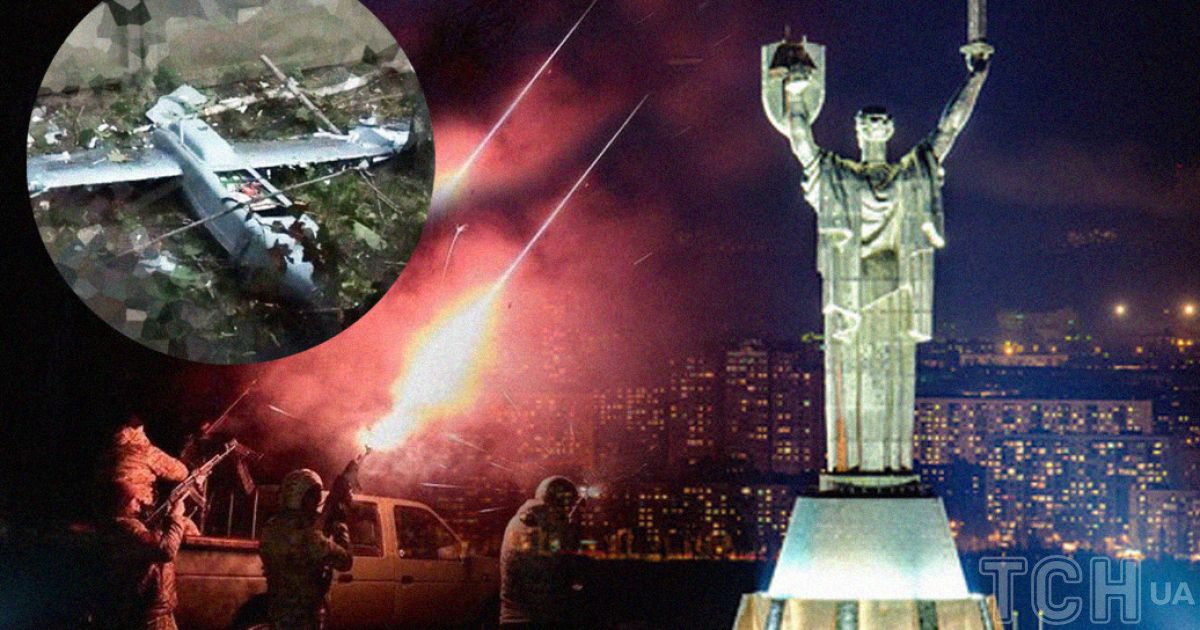
A drone of an unknown type was shot down in Kyiv / TSN.ua collage
A few days ago, the Russians attacked Kyiv with a new, unknown drone. The UAV flew at an extremely low altitude. It has been identified, and there's information on how the Russians plan to use it.
Read the full details from TSN.ua journalists' exclusive report.
On the night of July 20, the Russian occupiers once again attacked Ukraine. The enemy targeted five regions: Kharkiv, Poltava, Sumy, Chernihiv and Kyiv. According to the Ukrainian Air Force, the Russian army launched three "Iskander-M" ballistic missiles, an "Iskander-K" cruise missile, and 16 "Shahed"-type kamikaze drones. Russia attacked energy infrastructure in three Ukrainian regions.
"Russian drones attacked the facilities of the electricity transmission system operator in Poltava, Sumy and Chernihiv regions. Due to the attack, consumers in Poltava and Chernihiv regions were left without power supply."
Poltava under attack
Poltava region was attacked by kamikaze drones. According to the Regional Military Administration, strikes were recorded in Poltava district, cutting off power supply to 16 settlements. In Myrhorod district, civilian infrastructure was damaged, and a fire broke out, which was extinguished by rescuers.
Air defense also worked in Kyiv region. However, enemy targets reached the capital.
"As a result of the nighttime UAV air attack on Kyiv, debris from an enemy drone was preliminarily recorded falling in the Solomianskyi district of the capital."
Unknown drone
During this attack, the enemy used not only missiles and Shahed-type kamikaze drones but also a new, unidentified drone. Moreover, this new drone flew at an extremely low altitude of 20-30 meters, according to Defense Express.
"The enemy used not only missiles and Shahed-136 kamikaze drones to attack Ukraine but also a new, unidentified drone. And it was with this designation that he got into the report of the Air Force Command, which reported that thanks to the actions of mobile fire groups, anti-aircraft missile troops and electronic warfare systems, 13 of 16 Shaheds and one unidentified drone were shot down."
Differences from "Shahed"
Soon, images of the wreckage of this drone appeared online, showing it to be very different from the Shahed-136. It was also confirmed that it flew at a very low altitude of 20-30 meters, indicating it might be a kamikaze drone. Additionally, Defense Express received more photos of the downed drone.
"Based on these images, it appears to be a UAV with a possible wingspan of over 4 meters, tail fins on beams, a pusher propeller and a square-profile fuselage."
Similarity to other UAVs
The publication notes that the drone resembles the Russian ZALA 421-20, which has certain similar features. However, the ZALA 421-20 is a reconnaissance drone and likely would not fly at such a low altitude. Moreover, this type of drone is rare and likely no longer in production, as ZALA started promoting it in the early 2010s, and it no longer appears in the company's product catalog.
QUOTE: "In any case, the remains of this drone are being examined, which means its capabilities, features, as well as the manufacturer and components will be determined soon."
The new "Gerbera" drone
Ukrainian radio technology specialist Serhiy "Flash" Beskrestnov states that the new Russian UAV that recently reached Kyiv is called "Gerbera." Military correspondent Andriy Tsaplienko reported this on his Telegram channel.
"This is a new development that the Russians are positioning as a younger series of "Geraniums," hence the drone also received the name of a plant. The tasks of the "Gerbera" will differ from those of the "Geraniums." In addition to strikes on targets, it will also conduct reconnaissance and distract our air defense systems."
"Gerberas" to fly in swarms?
Beskrestnov also suggests that "Gerberas" might operate in swarms, complicating their detection and destruction. The emergence of this new type of Russian UAV raises concerns about increased aerial attacks on Ukraine.
Made of foam and plywood
According to Defense Express, "Gerberas" are made of foam and plywood to reduce costs. Inside, they found 3G and 4G antennas, as well as a modem with a SIM card. It is believed they are developed in the special economic zone "Alabuga" in Tatarstan. Despite this, the enemy decided to showcase it, revealing not only the name of the new UAV - "Gerbera", but also several additional and important details. The original video was shared by the Russian unit "Stalin's Falcons," closely associated with "Alabuga," where Shaheds are produced. The unit's patch even features the image of this Iranian drone alongside the Soviet flag. Given how and from what the Russian "Gerbera" is assembled, it seems the Iranian drone remains the pinnacle of technology for the workers of "Alabuga."
"Gerbera" can be produced in three versions: an electronic warfare drone, a kamikaze drone or a decoy. Based on what is known about the downed model, it was not an attack version."
However, the attack version deserves further attention. It uses a TV channel for targeting with a rather mediocre camera. Thus, the final targeting is done manually by the operator, similar to an FPV drone. Therefore, accuracy depends on the operator's skill. The video showed the operator missing the target. The fact that this footage was published suggests that the number of "Gerberas" is currently limited. Interestingly, the drone has a camera, whereas the Shahed attacks a pre-set coordinate.
"This suggests that the drone's range with a warhead is relatively short and within direct radio communication range. That is, within a few tens of kilometers or up to a hundred kilometers with a repeater. However, the first downed "Gerbera" was equipped with a 4G modem, allowing for a high-speed communication channel for video transmission in certain areas."
The flight range of this drone remains uncertain. However, it is likely to be within 300 km without a warhead. This would make it capable of reconnaissance missions, including detecting radar systems and transmitting information in real-time, potentially through the Ukrainian mobile network, as well as acting as a low-cost decoy target.
Enemy attack on July 29
It's worth noting that on the night of July 29, the enemy also attacked Ukraine. The occupiers launched an aviation missile and attack UAVs. However, air defenders managed to destroy almost all of the enemy's aerial targets, as reported by Air Force Commander Mykola Oleshchuk.
"Last night, the enemy attacked with a guided aviation missile Kh-59/Kh-69 from the airspace over occupied Donetsk region and 10 Shahed-type attack UAVs from Cape Chauda in occupied Crimea."
What was destroyed?
Anti-aircraft missile units and electronic warfare units of the Air Force, as well as mobile fire groups of the Ukrainian Defense Forces, were involved in repelling the air attack. As a result of the air defense battle, a Kh-59/Kh-69 guided aviation missile and nine "Shahed" UAVs were shot down. The aerial targets were destroyed in Dnipropetrovsk, Kherson and Kirovohrad regions.
Read also:
A PR campaign for kidnapping Ukrainian children launched in Russia: what is known
"Strong enemy": Special Operations Forces talk frankly about how the Russians fight