
Drones over Maidan: General reveals Putin’s new plan to attack Kyiv
Military expert Ihor Romanenko has detailed how the enemy is attempting to exhaust air defense systems, undermine the capital’s economy, and why drones are reaching the city center.

 Follow us on Google
An expert explains Russia’s shift to daytime aerial assaults on Kyiv
Russia has overhauled its tactics for aerial strikes on Kyiv. For two days running, the adversary has targeted the capital during morning, daytime, and evening hours—at times when thousands are commuting, conducting business, or attending classes. Consequently, these hostile attacks force children into basements, halt economic activity, and cut the transit links between the city’s banks as the metro system shuts down. Experts warn that Kyiv will remain Putin’s number one target until the end of the war, and that there is no reason to expect Russian attacks on the city to stop.
The enemy aims to paralyze life in Kyiv and its economy
Military expert Ihor Romanenko believes that the morning and afternoon drone strikes on Kyiv point to a change in the enemy’s tactics. The Russians prepare for these attacks meticulously, orchestrating them for their own maximum benefit and our maximum harm. The enemy identifies the approximate mix of assault weapons and the specific targets they intend to hit.
«Previously, the Russians struck across the whole of Ukraine, primarily at night. However, our defense system and ordinary citizens adapt quickly to such an attack pattern. Ukrainians—and in this case, Kyiv residents—seek and find ways to survive under these harsh conditions. The Russians know and see this well, as they conduct regular reconnaissance of the situation in the city. Their goal is to alter the components of these aerial strikes to maximise the deterioration of the situation in Kyiv, making the consequences more painful to destroy our economy—essentially driving people into shelters for hours and denying them the chance of a normal life,» Ihor Romanenko, military expert, retired lieutenant general, and former Deputy Chief of the General Staff (2006–2010), told TSN.ua.
The expert adds that the Kremlin is perpetually shifting its tactics for attacking Kyiv. The Russians have started their strikes at different hours: at dawn, at midnight, or by trying to prolong them across the entire night. With this, the enemy sought to strip Kyiv residents of something elementary—peace and nightly rest.
Why Russia has shifted to «low-cost» terror
«The Russians have abandoned simultaneous strikes across all of Ukraine. They lack the assets to strike a wide range of targets at full capacity. Therefore, they hit specific regions. They selectively attacked the Odesa region, then struck Lviv and its province, before moving on to Volyn. These strikes were carried out over a week, but they were methodical and constant. The enemy deployed both UAVs and ballistic missiles, but Putin lacks the assets for continuous massed offensives. That is precisely why the Russians are shifting to cheaper offensive means—"Shaheds"—and altering the timing of their attacks,» the expert explains.
Regarding Kyiv, the Russians seek to make attacks on the capital regular to deny residents any chance of respite. The goal of these strikes is to morally exhaust the inhabitants and, even more so, to drain air defense capabilities.
«Kyiv residents have grown accustomed to the Russians attacking the city primarily at night, with daytime strikes being less frequent. Now, the situation is starting to change. This undoubtedly affects the crews of missile and air defense units working round-the-clock. While other branches of the military have the option of rotating into reserve, the defenders of the skies do not. They work in shifts, but 24/7. This creates immense moral and psychological strain; eyes suffer extreme fatigue from monitor contact while engaging aerial targets. Soldiers must recalibrate for new periods when enemy attacks become more probable,» the lieutenant general says.
«Putin’s humanism» as a propaganda tool
The expert notes that Putin formerly aimed to project a «humane approach,» asserting that he targets Ukrainian facilities at night when they are purportedly empty.
«Yet all this was nothing but propaganda. The Russians targeted residential blocks and civilian infrastructure regardless. Now, morning strikes on Kyiv—carried out while children are in school and people are at their workplaces—demonstrate that „Putin’s humanism“ is over. In reality, it never existed,» Ihor Romanenko says.
The expert explains that strikes on Kyiv using isolated (jet-powered) drones indicate that the Russians want to keep the city under constant tension, even with a single UAV. This is because an air raid alert is triggered across the entire city as soon as an aerial target sets a course for the capital.
Many wonder why Russian drones manage to penetrate the city’s defenses.
«Because no country in the world possesses a 100% effective defense—particularly during massed air raids. We simply do not have enough interceptor systems or the munitions for them. The enemy is, regrettably, taking advantage of this,» Ihor Romanenko says.
Reconnaissance before strikes and manipulation of markings in Maidan
The lieutenant general does not rule out that some of the drones used in the two latest morning attacks were conducting reconnaissance.
«It is quite possible. Russia carries out reconnaissance before, during and after strikes. This is done continuously using various forms of intelligence, including ground, signals, radar, aerial, space and human intelligence. All of these operate constantly to gather information, forming the basis for the next air strike, ” Romanenko said.
The enemy assesses the condition of targets of interest while also evaluating its own capabilities and reporting to leadership for decision-making. It determines which systems to use and which targets to strike, setting preliminary tasks on how and when to conduct the attack. Final decisions are taken by the higher military and political leadership, based on available resources.
«Russia does not have sufficient means to sustain constant large-scale strikes, and this shortage has existed for a long time. However, it continues to seek opportunities and build up capacity, for example by combining drone attacks with ballistic missiles, ” he said.
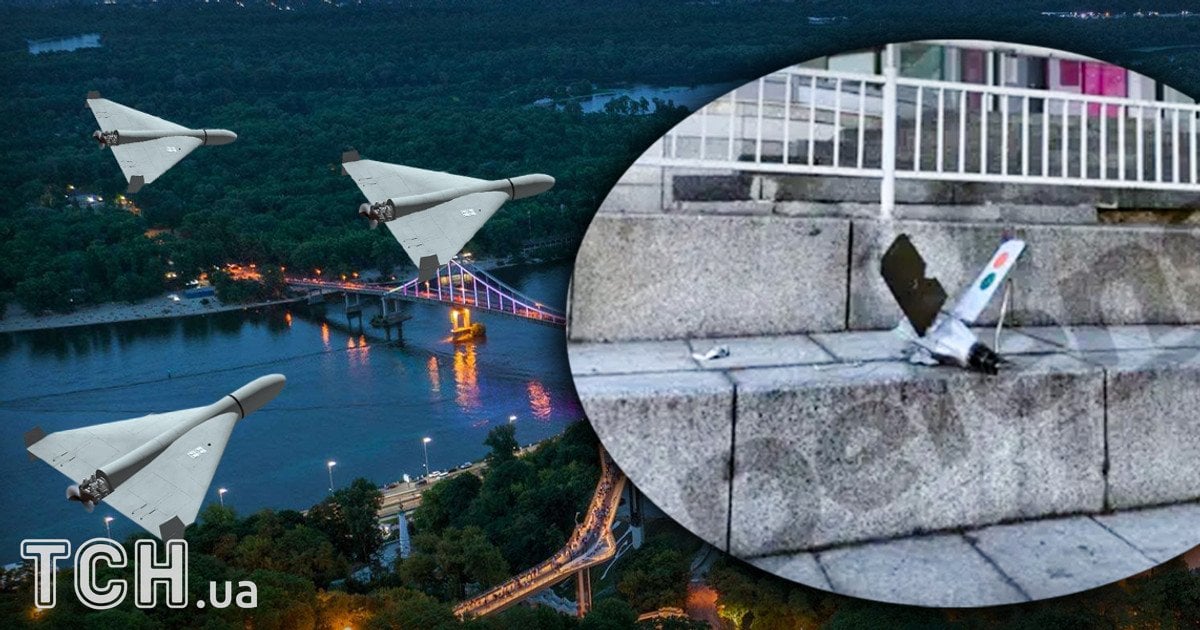
During the latest morning attacks, a Russian drone was shot down in central Kyiv. Debris fell near the stele on Maidan Nezalezhnosti. There was widespread discussion about a new Russian «Lancet» drone, which was reportedly capable of being remotely controlled by an operator during the attack on Kyiv. This version was later dismissed, with suggestions that the Russians had deliberately added parts from another drone with misleading markings to the one that was shot down in order to mislead.
«It is hard to say what it was. I do not speculate. The UAV fragments should be examined by specialists, who will draw conclusions. The key issue, in my view, is that this weapon reached central Kyiv. We need to ensure that it, whatever it is called, no longer reaches the capital’s center. Everything possible must be done to prevent such intentions from being carried out, ” the lieutenant general says.
A test for Ukraine and NATO from Putin
The expert does not rule out that the drone attack on central Kyiv was purely demonstrative—a «look what we can do» message, flying over Khreshchatyk and Maidan. It is a classic move from the Putin playbook.
Ihor Romanenko draws a parallel with the Russian Federation’s attack on Poland on September 10, 2025, when the Russians launched a coordinated aerial strike using over 20 UAVs, though they carried no explosive warheads.
«Essentially, Putin conducted a test for NATO’s air defense forces, and they failed it—intercepting only three UAVs. Despite possessing powerful fighters and modern anti-ballistic missile systems, the Europeans' response was incredibly sluggish. This was a reconnaissance mission to gauge how Europe would react to a real assault. Putin realized the Europeans would hesitate over whether to scramble their jets, and that their sophisticated ballistic defense systems lack short-range air defense cover, leaving them vulnerable to destruction. Only the French reacted appropriately, downing the Russian drones as they approached a submarine base. Therefore, this attack on Kyiv may have been staged solely for the Russian public, a demonstration of strength. We must learn from this and ensure it does not happen again,» Ihor Romanenko concludes.