
Massive strikes on energy sector: Why Russia targets Left Bank and whether blackouts are likely
Experts have explained why Russia attacks Left Bank and whether the energy sector will withstand strikes and freezing temperatures.

 Follow us on Google
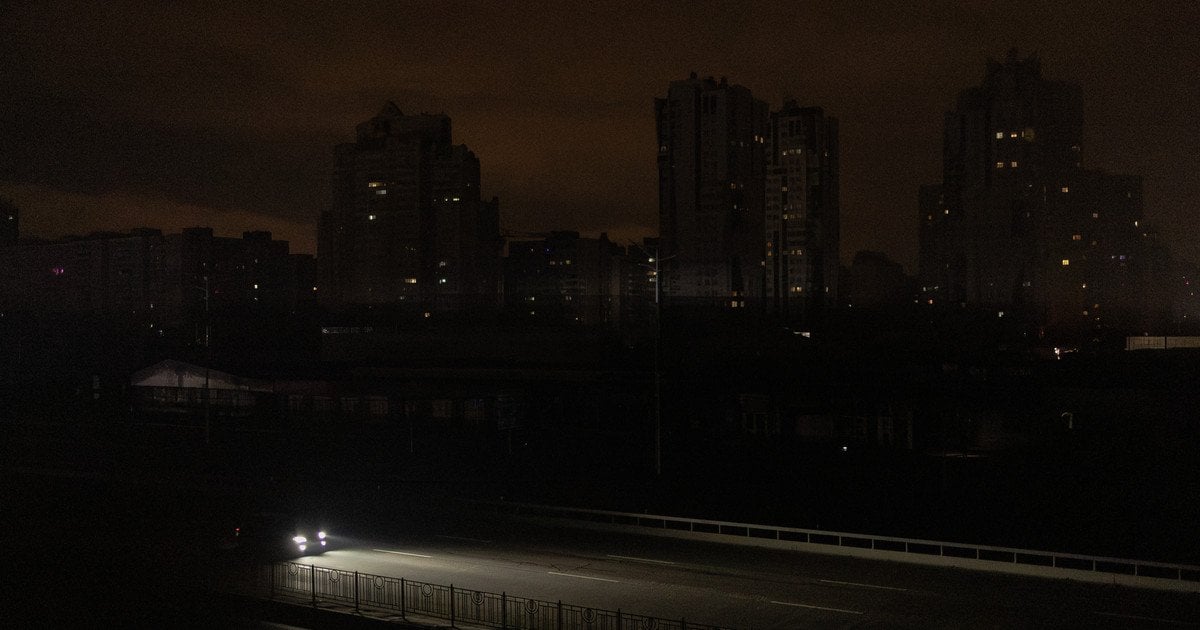
Russia is destroying Ukraine’s energy system / © Getty Images
More than 270,000 households have been left without electricity in the Kyiv region. Most of them are without power due to the weather: icing has caused outages on 220 power transmission lines. Wet snow and ice continue to bring down trees, while energy workers are struggling to reach the sites of the breaks. Besides the weather, Russian shelling has also caused damage — 90,000 households in the region alone are waiting for electricity to be restored.
Whether Ukraine’s energy system will withstand freezing temperatures and attacks was examined by TSN correspondent Valentyna Dobrota.
Borscht on a gas stove and life without a lift
From a dark refrigerator, Ms Anastasiia takes out the last portion of borscht she had saved for five-year-old Artemko.
“A day before the blackout, I cooked a pot of borscht and we had something to eat — we just needed to heat it up,” the woman said.
She used a gas stove she had purchased in advance.
Ms Anastasiia’s apartment, like the rest of Slavutych, depends entirely on electricity. The city of about 20,000 people was plunged into darkness after a Russian strike. For two days, Slavutych operated on generators, while critical infrastructure was powered by backup supplies.
Why Slavutych and the Left Bank are under threat
The city of energy workers has not been cut off by the enemy for the first time. Energy expert Sviatoslav Pavliuk explains the occupiers’ strategy:
“Slavutych is a major hub of Ukraine’s energy system, with a significant share of electricity passing through it. Strikes on Slavutych effectively mean strikes on the Chernihiv region. The Chernihiv and Sumy regions receive the most hits because they are on the edge of the energy system. Disabling such regions is technically easier and the consequences are more severe. These regions have civilians, production facilities and military units, which complicates both defense and civilian life,” he said.
Before Russia’s full-scale invasion, the Left Bank had a surplus of power generation. But following the occupation of the Zaporizhzhia Nuclear Power Plant and damage to thermal power plants, the energy system on the left bank of the Dnipro now depends on power transfers from the right bank.
Sviatoslav Pavliuk says: “Strikes on these substations — in Slavutych, near Zaporizhzhia and near Dnipro — are essentially strikes that prevent electricity from being transferred between producers and consumers over long distances, so to speak.”
Ukrenergo forecast for frosts of minus 17°C
Chairman of the Management Board of Ukrenergo Vitalii Zaichenko said the system is holding up but warned that a difficult period lies ahead:
“If we talk about shortages, there is probably a positive aspect here in that the government issued a relevant instruction to reduce the number of critical infrastructure facilities that were not disconnected, and they will now be disconnected. This will allow us, in effect, not to significantly increase consumer outages during the period of severe frosts that are forecast — minus 15 to 17 degrees at night and minus 10 during the day. But I am not talking about outages as a result of a dispatchers’ command; I am talking about emergency outages that may occur. In such cases, generators must be available. This is mandatory for all hospitals, and it is the responsibility of local authorities to ensure they are provided.”
Battery systems: a city’s survival experience
Together with Slavutych Mayor Yurii Fomichev, journalists went down to a school shelter where a battery system with a 120-kilowatt energy reserve has been installed. While children are on holiday, the site is operating as a permanent “Point of Invincibility”.
Yurii Fomichev said: “There were many people who came to charge their gadgets, bringing not just power banks but charging stations, EcoFlow units, Bluetti units — and all of it was working. By 6p.m., the batteries had dropped to 30% charge. Through the inverter, a command was sent to the generator, which switches on and starts charging them. This is a lot of money — not litres, but tonnes. If there had been no backup systems and we had been operating Points of Invincibility 24/7, it would have been a tonne a day. In reality, I think we spent about 20 times less thanks to backup power.”
Can the system be fully protected?
Andrian Prokip, head of energy programmes at the Ukrainian Institute for the Future, stresses the importance of decentralisation:
“Approaches will be revised, and I think they will be revised not only here but, based on our experience, in other countries as well. We can look at the situation in Berlin, because they are used to operating in conditions where everything is normal. They are not prepared for such emergency situations. And we now have the experience of how to recover quickly after attacks and how to be resilient to them.”
However, it is technically impossible to fully shield everything. As Vitalii Zaichenko explains:
“They use dozens of kamikaze drones, plus three to five missiles of different classes — from ballistic missiles to cruise missiles. This leads to very significant consequences for energy facilities. They take a long time to restore. It is unrealistic to cover them completely. Unfortunately, there are no technical solutions for that. There are technical solutions that we have already developed to protect transformers and relay control buildings — that is where the substation’s "brain" and control systems are located. We are already hiding those and can protect them. But this project has not yet been fully implemented.”
A substation the size of 10 football fields is simply too large an объект to be fully sheltered.
Adrian Prokip said: “The fact that some facilities are protected helps us to recover faster. Imagining that we can, in a short period of time, simply solve absolutely all problems is naive. But of course, one can ask whether more could have been done. Yes, more could always have been done.”
How to stop the attacks
Ukraine’s energy system has been withstanding Russian shelling for four years. There are two effective ways to force Russia to halt its energy attacks on Ukrainian civilians:
additional air defense systems;
asymmetric strikes against Russia.