
Ukraine overhauls anti-"Shahed» defenses: «Flash» explains new intercept concept
Ukraine is restructuring its counter-drone strategy, moving from point defense of cities to a multi-layered intercept system along the border.

 Follow us on Google
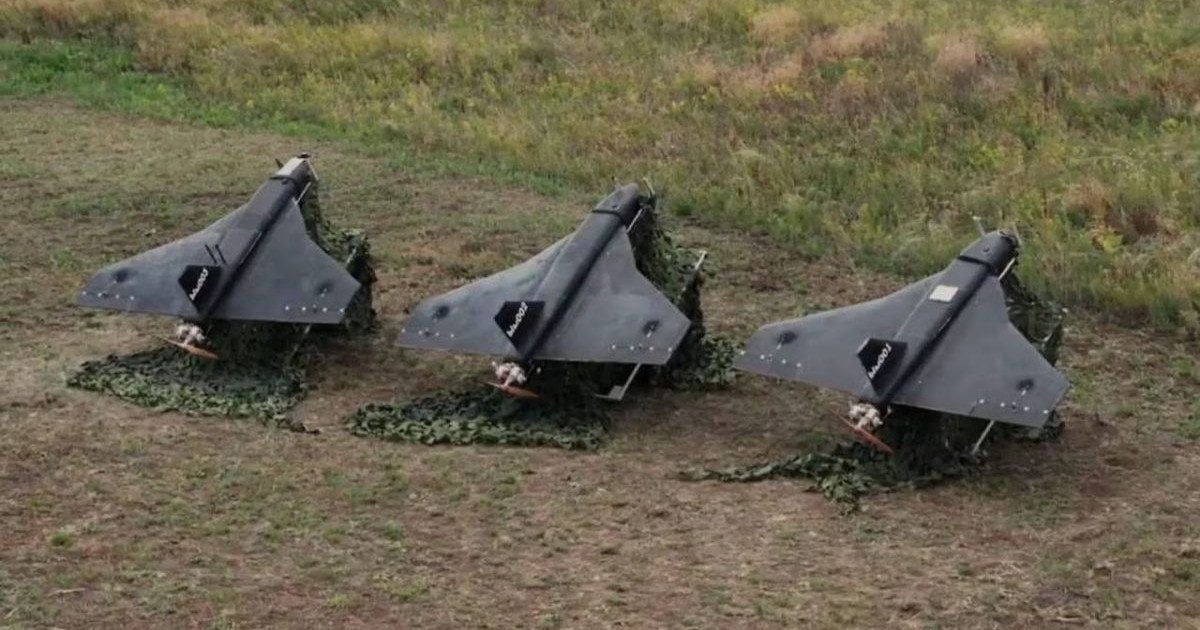
Russian «Shahed» drones / © Ukrainian Radio
Ukraine is shifting its approach to countering Russian drones. While focus previously remained on protecting major cities and rear-end facilities, the military is now building a multi-tier interception network along the border to stop hostile UAVs before they penetrate deep into the country.
Serhii «Flash» Beskrestnov, an advisor to the Ministry of Defense and specialist in electronic warfare (EW) and communications, outlined the new strategy on Radio NV.
According to Beskrestnov, the Russian military is progressively expanding its strike zone along the border. Previously, the high-threat strip reached roughly 10 kilometers; now, the occupiers are striking 30–40 kilometers deep, and in some cases, up to 80 kilometers.
«Flash» explained that the enemy aims to create a «dead zone» near the border—an area where neither military nor civilians can operate, and where industry and infrastructure are paralyzed.
«We now see them attempting to strike at 30–40 km to create a dead zone with no soldiers, no civilians, no production, and no infrastructure. They have begun hitting deeper into our rear—up to 80 km,» he stated.
Consequently, Ukraine is pivoting its defensive logic. The goal is no longer just covering specific cities but creating a system designed to intercept Russian drones on approach.
«Flash» says that building such a defense requires time, personnel, and hardware—specifically interceptor crews, EW systems, and radar stations, all of which remain in short supply.
«This is a challenge for us. We understand what needs to be done, but it requires time and resources, which are limited. We cannot close off the entire country instantly,» he noted.
A separate complication involves Russian forces shifting their drone frequencies. This forces Ukraine to constantly adapt its EW equipment to new ranges. While additional EW assets are being deployed to border zones, the sheer length of the frontier requires a massive amount of hardware.
Furthermore, «Flash» explained that partner aid cannot quickly fill this gap. Supplies of hundreds or even thousands of units do not fully solve the problem because the actual requirements are significantly higher.
The new concept envisions placing interceptors in multiple lines rather than at specific points. The idea is to down «Shaheds» long before they reach metropolitan areas.
«We need to build echeloned defense along our entire border. A „Shahed“ appearing near Dnipro or Kyiv should be considered a force majeure. Our interceptors should be lined up in several rows to strike down every „Shahed“ entering Ukrainian territory,» he explained.
According to the expert, the entire counter-drone system is undergoing a practical reconstruction, as the previous model no longer matches the enemy’s evolving tactics.
«Flash» also reported that Ukraine is already utilizing remote-controlled interceptors. This allows operators to stay in one location while the interceptors engage targets hundreds of kilometers away.
«We are implementing remote control—it’s impressive and it’s already working. Operators are in one place, while interceptors hunt UAVs in another,» he said.
However, interceptors cannot function effectively without radar. Radar stations are critical for detecting targets and guiding interceptors. While Ukraine produces its own interceptor drones, it currently lacks domestic production of the necessary radar units.
«Without radar systems, they don’t work at all because they can’t „see“ the „Shahed.“ We don’t have domestic production of these radar stations; we purchase them abroad,» «Flash» noted.
He added that while Russia faces similar issues, they receive assistance from China. Ukraine cannot rely on such a partnership and is forced to seek other supply sources while simultaneously scaling up its own capabilities.