
Kyiv, Dnipro, and Lviv under threat: Russia’s «new» drones and potential payloads
Russian forces have deployed a novel attack method against Ukraine.

 Follow us on Google

Russia uses new drones
In Nizhyn, Chernihiv region—located more than 200 kilometers from the combat zone—Russian troops executed a fresh assault tactic, dropping unidentified explosives from drones directly onto a central city street amid moving traffic.
Western media outlets, including The Wall Street Journal, report that Russia intends to target transportation routes and civilian vehicles even far from the front lines, placing peaceful residents in relatively secure Ukrainian regions at risk.
Analysts indicate that the Russian military is adapting its drone tactics. The new models operate via fiber-optic control, rendering them impervious to radio-electronic warfare jamming.
Military expert Oleh Zhdanov provided TSN.ua with insights into the attack type, the specific drones Russia is employing, and the territories they could reach.
Details of the Nizhyn attack
On September 19, Russian forces unleashed a new strike tactic against Nizhyn, releasing unidentified explosives from drones onto one of the city's main thoroughfares.
Nizhyn Mayor Oleksandr Kodola confirmed the incident.
"This represents a novel attack form; the Russians hadn't employed anything like it before. Specialists are currently determining the nature of those explosives. Fortunately, no one sustained injuries, and no vehicles were damaged," the mayor noted.
A dashcam from a vehicle traveling the street captured the strike moment. The footage shows an unidentified object plummeting onto the roadway and detonating, occurring around 8:30 a.m.

Moment of explosion in Nizhyn, September 19, 2025 / Screenshot from video by Oleksandr Kodola
A new type of Russian drone attacks
Russia has likely engineered a novel system to dramatically extend the flight range of fiber-optic FPV drones. Analysts assess that the occupiers may have utilized a heavy relay drone equipped with a substantial cable spool, to which strike drones with smaller spools attach.
Defense Express reports that Russian media describe a system enabling a several-fold expansion of FPV drone operational zones. This involves a specialized relay that extends the communication line between operator and combat drone by approximately four times.
However, the precise drone model used in Nizhyn remains unclear, Zhdanov told TSN.ua, deeming a fiber-optic FPV unlikely.
He explains that Russia is indeed advancing range enhancements, yet experimental spools max out at 40 kilometers.
"Typically, it's 15 kilometers, very rarely 20 for fiber-optic reels. The fiber can't withstand such distances yet. So, this remains a Russian Federation aspiration. Incidentally, ours too—we're tackling the same issue, but our drones already achieve 20 kilometers. We have systems ensuring that flight range for our FPV drones," Zhdanov stated.
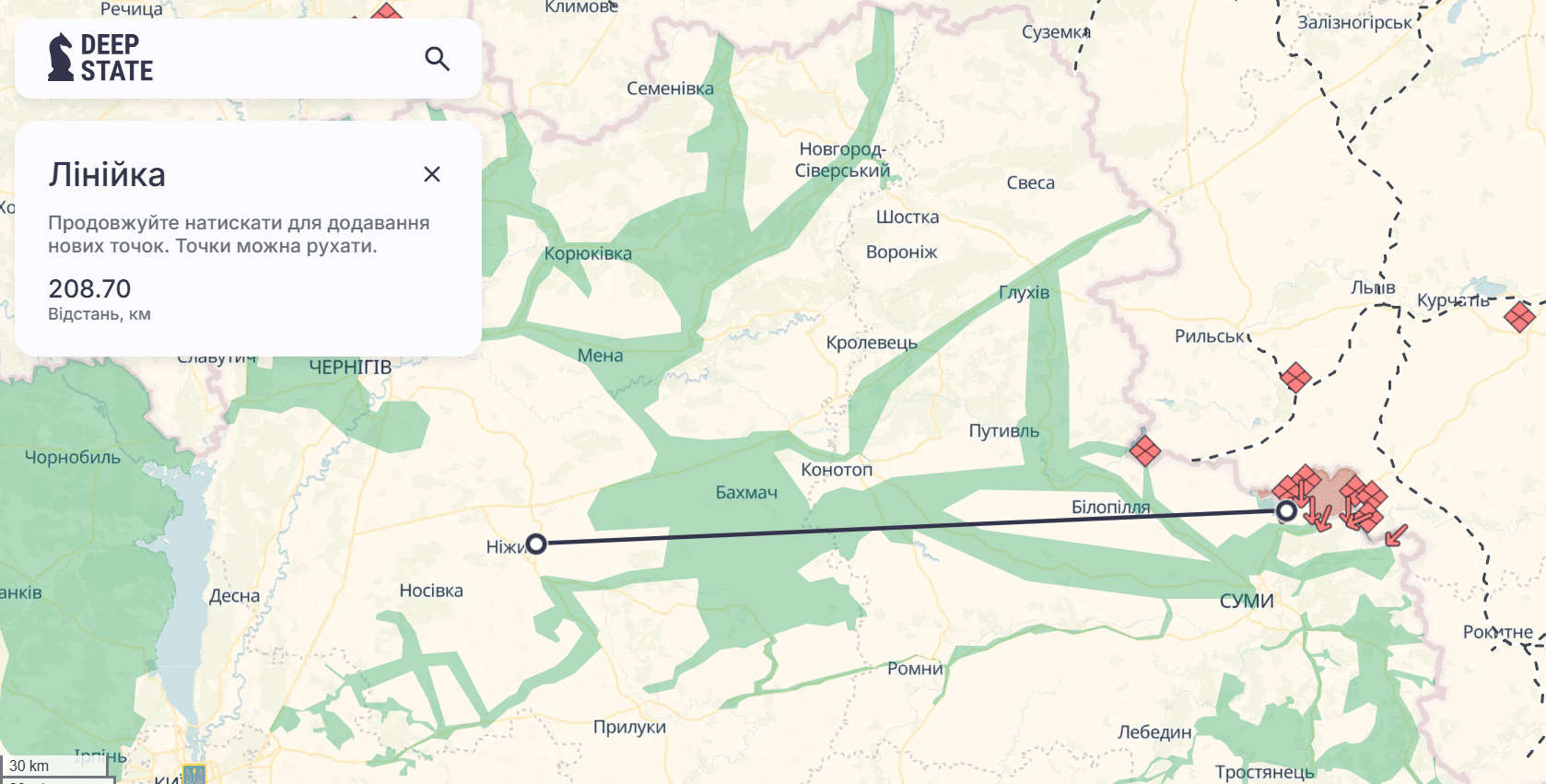
Nizhyn on the map
What was used in Nizhyn was most likely a cluster-type drone:
"This could be the same "Gerbera" in cluster configuration, simply ejecting a small explosive device. Something akin to PFM-1 "butterfly" mines used in anti-personnel applications. They have a very limited strike radius and virtually no fragments, as they're housed in plastic containers. But, as I recall, the payload ranges from 5 to 25 kilograms to trigger the charge, or a drop from significant height. The corresponding pressure activates it."
Weapons Russia used in Nizhyn
Video from the scene posted online shows no debris and only very small explosions, an expert said in explaining his assessment.
“No residents or cars were injured, fortunately. But the very fact of a strike or attack has a serious psychological impact on the local population. And if someone were hit, or if it landed at their feet, injuries up to a fatal outcome would be possible. In my view, these were most likely ordinary drones used at long range, of various types, but not fiber-optic drones,” said military analyst Oleh Zhdanov, adding that the public should wait for forensic results because his comments were only an assumption based on the video.
He explains that if it were a fiber-optic drone, it would not return—“a one-way ticket.”
“Because the reel unspools and it can’t pull all that fiber back. It would have to fall where the reel ends. If such a drone is found, then it’s a fiber-optic drone with a release mechanism—something like a cluster munition. I think it was likely a "Shahed"-type drone carrying a cluster payload instead of a warhead,” Zhdanov said.
If it was a "Shahed", he added, it could reach any Ukrainian city.
“Shaheds" can even reach Poland. They can fly to western regions—Lviv, Ivano-Frankivsk—on their main fuel supply, and with auxiliary tanks they’ve reached Gdansk. That’s not a problem,” the expert explains.
He also says that Russian forces have drones capable of operating 100–150 kilometers inside Ukraine.
“By the way, I think it was most likely a "Shahed", because there was information that they can control a "Shahed" at distances up to 150 kilometers. That means, first, the operator could adjust the drop site, and second, possibly return the drone after use if it was designed for that. Again, this is only an assumption based on what we saw and what the head of the city administration reported,” Zhdanov said.
Purpose of the attack
According to the military expert, the sole aim of such an attack is to terrorize civilians.
“This is simple terror aimed at forcing political concessions in Russia’s favor. Unfortunately, Russia uses every method and means to achieve its goals. Putin understands that no matter what he tries, the front line will not collapse. We are holding. Yes, we are retreating gradually, but not at the pace he needs. He is taking far heavier losses, and time is on our side. So Putin is trying to shape public opinion that a bad peace is better than a good war. Sadly, I would not rule out that they have resorted to such horror to terrorize the civilian population,” Zhdanov says.
He explains that missile and "Shahed" strikes on residential areas now cause far fewer casualties than before.
“Yes, people lose property and homes, but we have learned to take shelter. It is no longer like before, with dozens or hundreds wounded and dozens killed. Today casualties are far lower. If the number of victims is smaller, people can endure any tragedy. What do they need? They need mass casualties. The more victims, the greater the fear of Russian actions. That is why they are seeking new ways to frighten society,” he said.
What to expect next
Zhdanov believes the Nizhyn attack likely did not involve a fiber-optic drone but rather a "Shahed" or a similar model.
“They also have slightly smaller drones with shorter range. But here the key feature is that the drone must have a release mechanism—something like a cluster munition or a cluster charge on the drone itself. That’s important, because not every drone can be adapted for that type of payload,” the expert explains.
He recalls earlier cases of "Shaheds" carrying mines.
“That’s why I suggested it. We know "Shaheds" can carry mines—anti-tank mines that can be dropped to mine an area. So why not load anti-personnel mines? Given the flight height and speed, the scattering would be wide, and these small explosions—on the one hand like firecrackers, but on the other we understand this is war. The front is not far away, and the explosives could be more powerful. Most likely it was a cluster-type "Shahed". We’ll wait for the forensic results”.
According to the military analyst, Russian forces could carry out similar attacks on regional centers and reach Kyiv, Dnipro, Lviv or other cities.
“Anything is possible. Especially since the Gerbera can loiter over Kyiv for hours… Or other drones can fly from Troyeshchyna and then head southwest from Kyiv. Why not? A lone drone, seemingly a reconnaissance craft, could drop explosives over the city center. That would create panic among the population,” Zhdanov says.